

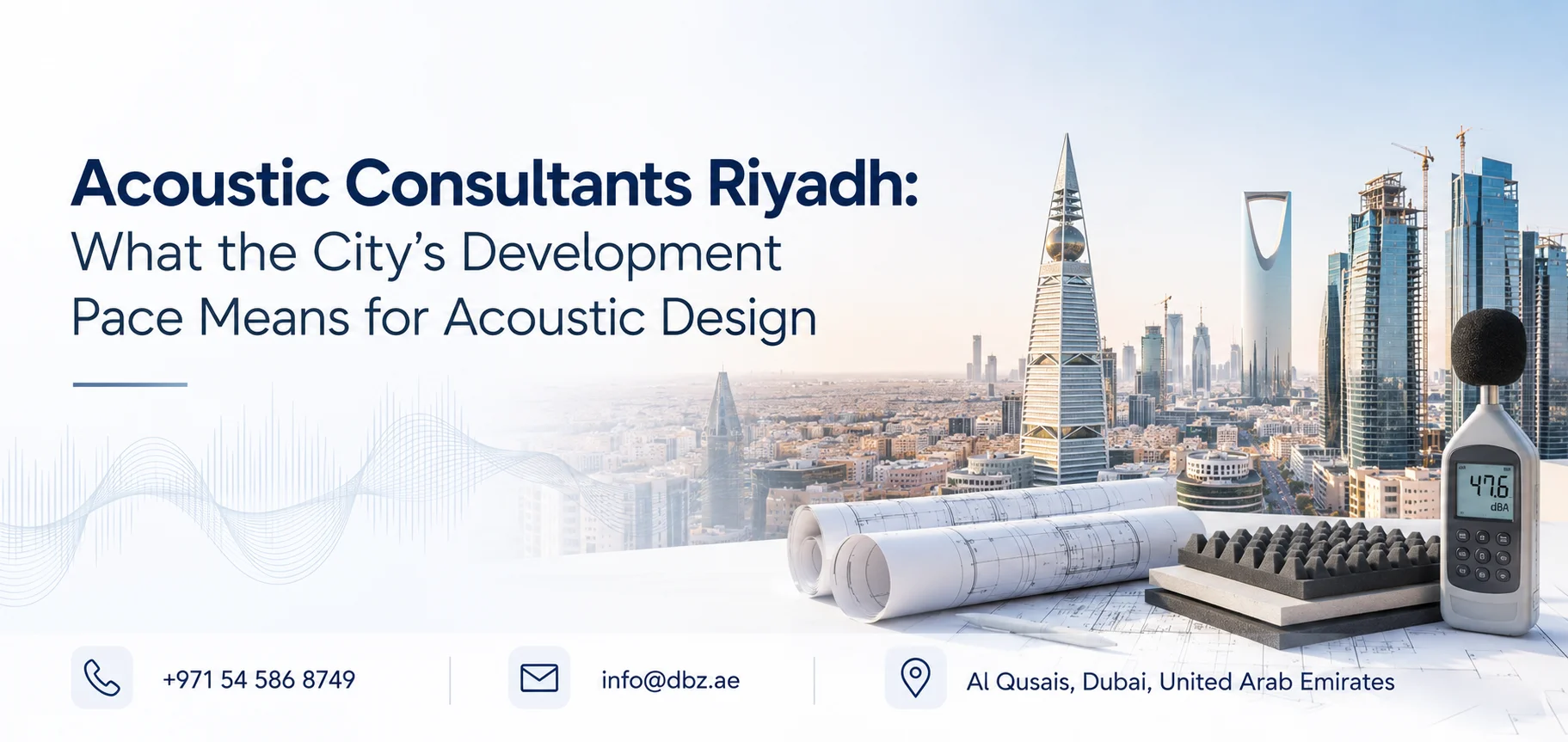
Riyadh is building at a pace few cities in the world can match – giga-projects, mixed-use towers, hospitality developments, and entirely new districts moving from masterplan to construction in timeframes that would be unusual almost anywhere else. That speed creates a specific risk for acoustics: when design and construction move fast, acoustic requirements are one of the details most likely to get compressed or skipped, and one of the most expensive to fix after the fact.
This guide covers what acoustic consultancy actually involves for Riyadh projects, why the city’s development pace changes the calculus, and what to check before engaging a consultant.
Why Riyadh’s Pace Raises the Acoustic Stakes
Here’s the practical reality worth planning around: acoustic performance is determined largely by decisions made at design and early construction stage – wall assemblies, floor build-ups, MEP routing – and those decisions are hardest to reverse once construction has moved past them. On a compressed project timeline, acoustic review can easily become an afterthought squeezed between structural and MEP coordination, rather than a parallel workstream from day one.
Large mixed-use and hospitality developments, in particular, tend to have acoustic requirements that touch nearly every discipline – structural (floor mass and isolation), MEP (mechanical noise and vibration), architectural (partition types and room layouts), and facade (external noise ingress). Fast-tracked projects that don’t build in dedicated acoustic review at each of these intersections tend to discover gaps only once occupants move in.
What an Acoustic Consultant Actually Delivers on a Riyadh Project
A full-scope acoustic consultancy engagement typically spans several distinct services:
| Service area | What it covers |
| Architectural acoustics | Room acoustics, sound quality within individual spaces |
| Building acoustics | Sound insulation between spaces – walls, floors, ceilings |
| Mechanical acoustics | HVAC, plant, and equipment noise and vibration control |
| Noise control | Broader noise mitigation strategy, including external sources |
| Acoustic testing | Field measurement to verify the finished building meets design targets |
| Soundproofing advisory | Material and construction guidance for specific noise problems |
A project that only engages a consultant for one of these – architectural design review, say, without mechanical acoustics coordination – often ends up with a beautifully designed space undermined by HVAC noise nobody assessed until commissioning.
Development Types Where This Matters Most in Riyadh
Riyadh’s current development mix creates specific acoustic pressure points:
- Large-scale mixed-use districts – combining residential, retail, hospitality, and office uses in close proximity, where noise transfer between uses is a real design risk if not planned for early.
- Hospitality and giga-project developments – where guest experience is directly tied to room and space acoustics, and international operators often bring specific acoustic performance standards into their brand requirements.
- High-density residential towers – where unit-to-unit and floor-to-floor sound insulation is one of the most common post-occupancy complaints if under-specified.
- Cultural and entertainment venues – auditoriums, theaters, and performance spaces where room acoustics is central to the space actually functioning as intended, not an afterthought to the architecture.
A Practical Timeline for Getting Acoustics Right
- Concept design – identify acoustic requirements and risk areas based on the building’s mix of uses and adjacencies.
- Schematic and detailed design – specify wall, floor, and ceiling assemblies; coordinate with MEP on equipment noise and routing.
- Construction documentation review – confirm specified acoustic assemblies remain intact in the issued drawings, since value engineering passes are a common place acoustic specifications get quietly changed.
- Construction-phase site visits – spot-check that installed assemblies match specification, particularly for isolation details that are easy to compromise on site.
- Post-construction testing – field-verify sound insulation and noise levels against design targets before final handover.
Compressing this timeline down to a single design-stage review, without construction-phase checks, is one of the more common ways acoustic performance ends up falling short of what was actually specified on paper.
Questions Worth Asking a Riyadh-Focused Acoustic Consultant
- Which of the core acoustic disciplines – architectural, building, mechanical, testing – do you cover directly, versus subcontracting out?
- Can you work across a fast-tracked project timeline without skipping construction-phase verification?
- Do you have experience with the specific building typology – hospitality, high-rise residential, mixed-use – relevant to this project?
- Are you independent of materials suppliers and contractors, so specification recommendations aren’t tied to a particular product line?
- Can you provide post-construction field testing, not just design-stage advisory?
How DBZ Approaches Acoustic Consultancy
DBZ is an independent acoustic, noise, and vibration consultancy with more than a decade of combined experience across commercial, hospitality, residential, educational, healthcare, and recreational projects. The practice covers the full range of core disciplines – architectural acoustics, building acoustics, mechanical acoustics, acoustic testing, and soundproofing advisory – under one team, rather than splitting the work across separate specialists who may not coordinate closely.
As independent consultants, DBZ’s process starts with identifying and isolating the actual noise or acoustic risk, followed by measurement, analysis, and engineered recommendations – giving clients and their contractors a clear, specified path to resolving the issue rather than a generic product recommendation.
A note worth flagging directly: DBZ’s core published presence describes the practice as based in Dubai, serving Dubai and Abu Dhabi. For a Riyadh-based engagement specifically, it’s worth confirming directly what remote design-stage consulting and on-site testing arrangements are available before finalizing project scope.
Planning Acoustics Into a Fast-Moving Project
Riyadh’s development pace doesn’t have to come at the cost of acoustic quality – but it does require treating acoustic consultancy as a parallel workstream from concept design onward, not a late-stage check. Projects that build this in from the start consistently avoid the costly retrofits and post-occupancy complaints that come from treating acoustics as an afterthought.
Discuss your project’s acoustic scope – call +971 54 58 68749 or email info@dbz.ae.


