

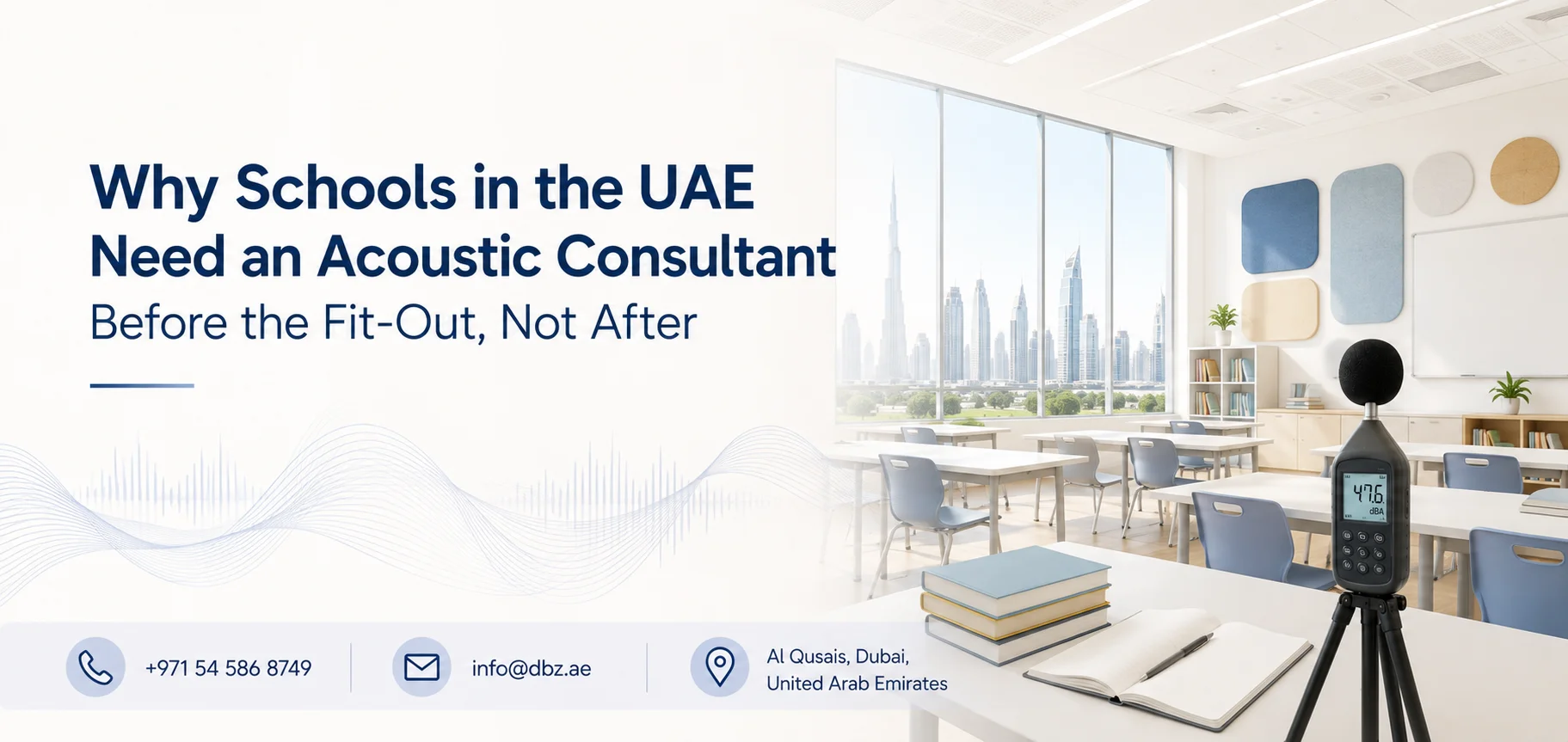
A teacher in Abu Dhabi once told me she’d started losing her voice by Wednesday most weeks, and it had nothing to do with a cold. Her classroom had a hard vinyl floor, a suspended ceiling with almost no absorption, and glass along one whole wall facing a busy road. Every lesson meant competing with reverberation bouncing off every hard surface in the room, on top of traffic noise leaking through the glazing. She wasn’t imagining the strain. The room was working against her from the moment she walked in.
That situation is far more common than most people assume, and it’s exactly the kind of problem an acoustic consultant is meant to catch before a school ever opens its doors. Classroom acoustics affect two things that matter enormously in education: how clearly children can understand speech, and how much vocal strain teachers are under all day, every day. Younger children in particular need a much higher signal-to-noise ratio to understand speech than adults do, simply because their brains are still developing the ability to fill in gaps when words get lost in background noise or echo. A classroom that sounds “a bit lively” to an adult visitor can genuinely be a barrier to learning for a six year old sitting at the back.
When we consult on schools, whether it’s a new campus being designed from scratch or an existing building where complaints have already started, we’re really looking at three things together. Reverberation time inside teaching spaces, because too much echo destroys speech clarity even when everyone in the room is being perfectly reasonable about noise. Background noise intruding from outside, from mechanical plant, from corridors, or from neighbouring classrooms, because a whisper-quiet room still fails if you can hear the class next door through a party wall. And sound transmission between spaces generally, which matters just as much in a school as it does anywhere else, arguably more, because you’ve got dozens of rooms in close proximity all trying to function independently at the same time.
Open-plan and flexible learning spaces, which a lot of newer schools in Dubai are moving toward, make this considerably harder. It’s a nice pedagogical idea, breaking down the traditional four-walls-and-a-door classroom into shared, flexible zones. Acoustically, though, it’s a real challenge, because you’re deliberately removing the sound isolation that a closed classroom used to give you for free. Getting that right needs proper acoustic design input at the concept stage, not a retrofit of screens and rugs once teachers start complaining that they can hear the group next door doing a completely different lesson.
Gymnasiums, music rooms, and assembly halls bring their own set of problems, mostly because they’re large volumes with hard surfaces built for durability rather than sound absorption. A sports hall with a concrete block wall and a hard ceiling can produce reverberation times several times higher than what’s appropriate for speech or for the wellbeing of the people using it every day. Music rooms need isolation from the rest of the school as much as they need decent internal acoustics, otherwise you end up with a trumpet lesson bleeding into a maths class two doors down, and neither teacher is happy about it.
There’s a regulatory and design-standard angle too. Educational facilities in the UAE increasingly reference international acoustic performance benchmarks for classroom reverberation time and background noise, and schools going for sustainability or wellbeing accreditation often need acoustic performance data as part of that process. Having a consultant measure and document performance against these benchmarks isn’t just good practice, it’s frequently a genuine project requirement, and it’s a lot easier to demonstrate compliance when the acoustic strategy was baked into the design rather than bolted on afterward.
What we actually do on a school project is straightforward, even if the underlying engineering isn’t. We assess the design or the existing building, measure where relevant, model the expected acoustic performance of classrooms, corridors, halls and specialist rooms, and put together clear recommendations, covering things like ceiling absorption, wall construction, door and glazing selection, and mechanical system noise control. We’re independent, so we’re not selling anyone a particular ceiling tile or acoustic panel brand. Our job stops at telling the architect, contractor or school operator exactly what will work and why, and then it’s up to them who they buy from and who installs it.
Special educational needs provision deserves its own mention here, because it’s often overlooked in general classroom acoustic planning. Children with auditory processing difficulties, hearing impairments, or conditions like autism can be significantly more affected by poor room acoustics and background noise than their peers, sometimes to the point where a noisy classroom becomes a genuine barrier to inclusion rather than an inconvenience. Schools that are serious about inclusive education need acoustic performance targets that account for this, not just the generic minimum, and that’s a conversation worth having with a consultant early rather than after a specific child’s needs highlight a gap in the room.
Outdoor spaces matter too, more than people tend to assume when they’re focused on the classrooms themselves. Playgrounds, sports courts and drop-off zones in Dubai often sit close to busy roads, and the reverse problem applies just as much: noise generated by hundreds of children at break time carrying into nearby classrooms still in session, or into residential buildings next door if the school shares a boundary with housing. Site layout, boundary treatment and building orientation all play a role in managing that, and it’s far easier to get right at masterplanning stage than to retrofit once the playground is already poured.
The cost of getting this wrong isn’t abstract. It shows up as teacher fatigue, as complaints from parents about children struggling to concentrate, and eventually as expensive remedial acoustic treatment fitted into a building that’s already operating, disrupting classes to fix a problem that could have been designed out from day one for a fraction of the cost. If you’re involved in a school project anywhere in Dubai or Abu Dhabi, whether it’s a new campus, an extension, or an existing building where the classrooms just don’t sound right, DBZ’s consultants can assess the space and tell you exactly where the problem is and how to solve it, backed by measurement and standards rather than guesswork.


